As told to the VNA by Jill Brayton
When my mother, Margaret Sullivan, had her stroke, it was the kind of news no one is ever ready for. It was February 2023, a quiet Saturday morning, when everything changed.
My mother had gone to bed Friday night as usual. The next morning, her husband, Gene, my stepfather, couldn’t find her. He thought she’d gone for a walk, but when she didn’t return, he called my husband. She wasn’t with us, so I knew something was wrong. I told Gene to check the bedroom and the bathroom — and if she wasn’t there, I was coming over.
I arrived just as the ambulance did. I ran up the stairs and found her on the side of the bed, still in her little pajamas, unresponsive. The paramedics took her right away.
At the hospital, the doctors told us the words you can never unhear: she had suffered a massive stroke. Her chances of survival were about one percent. If she did survive, she would never walk, speak, or eat again. My sister and I, along with Gene, had to face the truth — our mother, the woman who had always been so full of life, was not coming back to us in the way we knew her.
We didn’t have to think long about what to do. Mom had always made her wishes clear. “If you ever put me in a home,” she used to joke, “I’ll come back and haunt you.” We knew she wanted dignity, peace, and love at the end — not machines and tubes.
That’s when I reached out to a friend and said, “I want her to go to the VNA Hospice House.” Miraculously, a room was available.
When we arrived at Hospice House, the first thing my family said was, “Oh my gosh, this place is absolutely beautiful.”
I remember looking around at the serene rooms, the gardens, the screened porches, and thinking, Mom will be so happy here.
Each patient’s room opened onto a private screened porch. My brother-in-law set up his computer out there, moving in and out quietly as we all sat together. The peace of the place was almost tangible, it wrapped around us like a blanket.
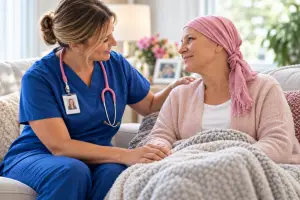
What struck me most wasn’t just the care my mother received, but the care we did. The nurses and aides came in constantly — not just to check on her, but to check on us. “Are you okay? Do you need anything?” they’d ask. The two social workers took time to listen to our memories. “Tell me about your mom,” they said. “Tell me about her life.”
She was 87 but lived with such grace and vitality. She walked three miles a day. And just a week before her stroke, we had taken a girls’ weekend at my sister’s house. We went to the zoo with her great-grandchildren and laughed the whole time. During that car ride, she said for the umpteenth time, “Don’t forget—if something ever happens to me, don’t put me in a convalescent home. Let me go.”
Those words said so soon before her stroke became a gift, a clear reminder that we were honoring her wishes.
At VNA Hospice House, the kindness seemed endless. Volunteers stopped by constantly, offering water, soda, or just quiet company. They even cooked us breakfast and brought it to the room. Every detail, every gesture, was filled with compassion.
One day, a man with striking blue eyes came in to fluff my mom’s pillow and tuck the sheets in her bed. I later learned it was Lundy Fields, the CEO of VNA, who also volunteers as a CNA once a month at the Hospice House. That kind of humility and care spoke volumes about the heart of the organization.
Faith was everything to my mom. She went to church every morning at 7:00. The social worker at Hospice House helped arrange for a eucharistic minister from my mom’s church to come and pray with us. She recognized my mother immediately: “I give her communion every morning.” She gave each of us a small wooden cross, a keepsake I’ll treasure forever.
When my mother passed, it was peaceful. One of Gene’s daughters, a nurse, was with us and quietly said, “Your mom stopped breathing.” We hadn’t even realized it at first; the moment was that gentle, that calm.
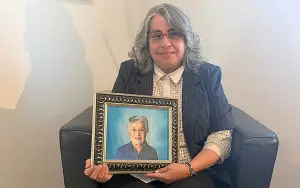
My mom — Peggy, as everyone called her — was truly the light of our family. She volunteered at church, read to residents in convalescent homes, and taught literacy classes. She brought our family together through her cooking and her laughter. Every grandchild and great-grandchild adored her.
There isn’t a single person who met her and didn’t love her. And in those final days at VNA Hospice House, surrounded by peace, compassion, and love, she was exactly where she was meant to be.
When I think back on it now, I can only say this: it was perfect. From the moment we walked through the doors until the moment she left us, there wasn’t a second she suffered. VNA Hospice House was more than a place — it was a blessing.